

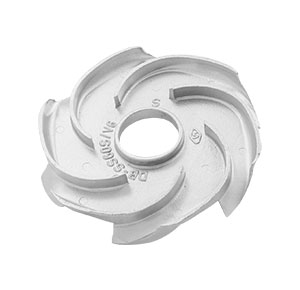
Pumps don't go from full steam to struggling overnight - it's a gradual decline that sneaks up on you. Small efficiencies get eaten away bit by bit and flow starts to get wobbly, power draw goes up, and wear and tear takes its toll, turning what used to be a planned maintenance schedule into a whole lot of emergency repairs. Long before operators notice the symptoms, the root cause has already settled into the metal itself. Pump parts castings define that reality. They shape how fluid moves, how stress is absorbed, and how long a pump remains economically viable in real industrial service.
This subject is often oversimplified. Casting quality is treated as a procurement checkbox rather than a performance driver. That mindset is costly.
Casting Geometry and the Reality of Flow Behavior
Every pump relies on internal geometry to convert rotational energy into controlled fluid movement. That geometry is formed first in the casting stage, not during machining.
Minor deviations in volute curvature, diffuser angles, or impeller passage symmetry alter velocity distribution. These changes create internal turbulence zones that do not appear in design calculations but emerge immediately during operation. Once formed, these zones consume energy continuously.
Accurate pump parts castings preserve hydraulic intent by maintaining uniform cross-sections and smooth directional transitions. This allows pressure recovery to occur as designed instead of being disrupted by localized flow separation. Over long operating hours, that difference becomes visible in energy bills and output consistency.
Internal Surface Condition and Its Compounding Effect
Surface roughness inside a pump is not a finishing detail. It is a performance variable.
Rough cast surfaces thicken boundary layers and increase friction losses. In high-capacity pumps, this friction converts directly into higher shaft power demand. The impact is gradual, which makes it easy to ignore, but it never stops accumulating.
Controlled molding and finishing practices produce smoother internal surfaces that remain stable throughout service life. Pump parts castings manufactured with surface integrity in mind maintain predictable hydraulic resistance instead of degrading unevenly. This stability protects efficiency curves from slow distortion.
Metallurgical Consistency and Wear Progression
Wear behavior is dictated less by material name and more by material structure.
Casting defects such as porosity, segregation bands, and uneven hardness create weak points under abrasive or erosive flow. Once fluid particles exploit these weak zones, wear accelerates unevenly, leading to imbalance and secondary damage.
Uniform microstructure slows this process. When hardness and grain distribution remain consistent, wear progresses gradually rather than aggressively. Pump parts castings produced under disciplined metallurgical control extend component life by resisting localized attack instead of surrendering to it.
Fatigue Resistance Under Operating Cycles
Industrial pumps experience constant variation. Start-ups, shutdowns, throttling, and fluctuating loads introduce cyclic stresses that challenge structural integrity.
Internal casting flaws magnify these stresses. Shrinkage cavities and residual stresses concentrate load, allowing cracks to form invisibly before reaching critical size.
Sound pump parts castings distribute stress evenly across the component. Proper stress relief and defect control prevent fatigue damage from gaining momentum. Failures become rare rather than sudden.
Dimensional Stability Over Time
Initial alignment does not guarantee long-term reliability. Geometry must hold under temperature, pressure, and time.
Castings that distort during operation increase internal clearances and disrupt alignment. Volumetric efficiency drops, bearing loads rise, and seals fail earlier than expected.
Stable pump parts castings resist thermal movement and mechanical creep. Clearances remain controlled, shafts stay aligned, and rotating assemblies maintain balance. Reliability improves because geometry remains consistent instead of drifting.
Maintenance Behavior Shaped by Casting Integrity
Maintenance outcomes are determined years before the first service interval.
Castings with clean chemistry and structural soundness respond well to welding and machining repairs. Repairs hold, distortion remains minimal, and service life extends without creating new failure points.
Inferior pump parts castings resist repair. Cracks return, weld zones weaken, and replacement becomes unavoidable. Maintenance costs rise not because of poor practices, but because the base material does not support recovery.
Energy Consumption and Hidden Cost Accumulation
Energy consumption dominates pump operating costs. Even small efficiency losses matter when pumps run continuously.
Casting-induced inefficiencies increase power demand hour after hour. Over multi-year service cycles, this additional energy usage often surpasses the initial cost difference between casting grades.
Efficient pump parts castings protect long-term operating budgets by preserving hydraulic performance. This advantage rarely appears in short-term evaluations but becomes decisive across the full lifecycle.
Downtime Risk and Operational Exposure
Unplanned downtime rarely originates from a single event. It grows from accumulated weaknesses in structure, wear resistance, and alignment.
Emergency failures disrupt production schedules and stretch maintenance capacity. These indirect costs escalate quickly, especially in continuous-process industries.
By minimizing defect-driven degradation, pump parts castings reduce operational risk exposure. Reliability improves through inherent integrity rather than reactive intervention.
Total Cost of Ownership as the Final Metric
Purchase price reflects only the beginning. Total cost of ownership reveals the truth.
Energy usage, maintenance labor, spare consumption, downtime losses, and replacement timing all respond to casting quality. Pumps built on weak cast foundations consume more resources and fail earlier.
High-quality pump parts castings flatten these cost curves. Operating expenses stabilize, maintenance becomes predictable, and asset planning gains clarity instead of uncertainty.
Practical Casting Quality Indicators That Directly Predict Pump Performance
Casting quality often sounds abstract during procurement discussions, yet its impact becomes concrete once a pump enters service. Certain indicators consistently separate cast components that perform reliably from those that degrade early. These indicators are not theoretical benchmarks; they directly influence efficiency retention, wear behavior, maintenance frequency, and lifecycle cost. Evaluating these factors early reduces uncertainty later, when corrective action is expensive or impossible.
The table below links critical casting attributes to their real operational consequences inside industrial pumps.
| Casting Quality Indicator | What It Controls in Operation | Impact on Flow Efficiency | Impact on Wear Life | Impact on Total Cost of Ownership |
|---|---|---|---|---|
| Dimensional consistency across batches | Internal flow symmetry and clearance control | Maintains stable pressure recovery and minimizes recirculation losses | Prevents uneven wear caused by misalignment | Reduces energy drift and repeat machining costs |
| Internal soundness (low porosity, shrinkage control) | Structural stress distribution | Prevents turbulence initiation at defect sites | Slows crack initiation and erosion acceleration | Lowers failure risk and emergency downtime |
| Surface finish uniformity | Boundary layer behavior | Reduces frictional losses over long run times | Produces predictable, gradual wear patterns | Sustains efficiency and delays overhaul cycles |
| Metallurgical uniformity | Resistance to abrasion and fatigue | Prevents performance decay caused by localized degradation | Extends impeller and casing service intervals | Cuts spare replacement and repair frequency |
| Thermal and mechanical stability | Geometry retention under operating conditions | Preserves volumetric efficiency over time | Protects bearings and seals from secondary damage | Stabilizes long-term operating and maintenance budgets |
Each of these factors reinforces the others. When one is compromised, the effects multiply rather than remain isolated. This is why pump parts castings should be evaluated as performance-critical components, not interchangeable structural shells.
Conclusion
Pump performance is often discussed in terms of design and system optimization. In real industrial environments, outcomes are determined by physical realities inside the pump casing. Geometry accuracy, metallurgical integrity, surface condition, and dimensional stability all originate in the casting stage.
Treating pump parts castings as engineered assets rather than interchangeable commodities changes everything. Flow efficiency holds longer, wear progresses predictably, failures decline, and ownership costs fall. In industrial pumping, casting quality is not a secondary detail. It is the structural foundation that decides whether a pump remains an asset or becomes a liability.