

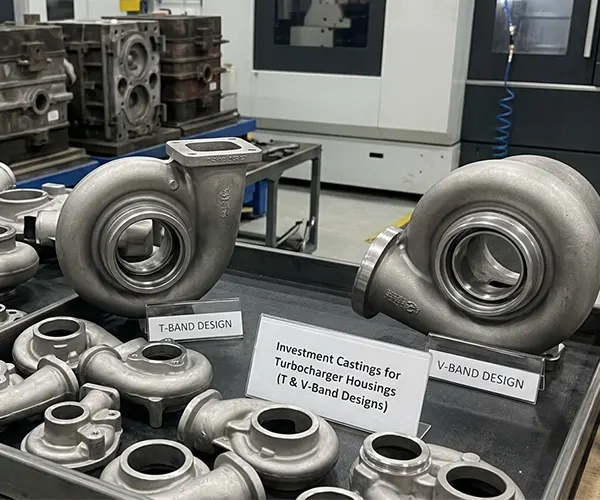
High-performance investment castings for turbocharger housings in demanding automotive applications
Investment castings for turbocharger housings are the preferred choice for high-temperature and high-performance applications, given the exacting environments turbochargers function in. Easily identified by their conch-like spiral shape, turbocharger housings come in single and dual internal passages (volutes) with rectangular (T) and circular flanges (V-band). The flanges themselves may be single scroll (referring to a single volute) or twin scroll by design.
At Super Quali Cast, we are a leading manufacturer of investment castings for turbocharger housings, producing all the above-mentioned configurations. Our T and V-band single and twin scroll housings are made with austenitic stainless steel that justifies the ‘hot side’ tag associated with turbocharger housings. We supply our turbocharger housing castings to domestic and international tier-1 suppliers and OEMs.
Investment Casting Process for Turbocharger Housings
- High-Precision Molding: Forms uniform shells and inner cavity.
- Gravity Pouring: Minimizes misruns and geometric inaccuracies.
- Heat Treatment: Enhances material properties such as hardness and strength.
- CNC Machining: Ensures tight tolerances and excellent surface finish.
- Final Inspection: Visual and physical checks using universal testers and precision gauges to ensure defect-free output.
Technical Specifications of Our Turbocharger Housing Castings
| Specification Area | Details |
|---|---|
| Development & Sampling | 25-40 days |
| Casting Process | Investment Casting, Lost-wax Casting |
| Material Grades | Austenitic Stainless Steel |
| Industry Standards | ASTM A351, ASTM A297, ASTM A957, DIN EN 10295, ISO 8062 |
| Shell Building Media | Ceramic, Stucco |
| Casting Weight Range | 2 kg – 22 kg |
| Maximum Dimensions | 350 mm x 350 mm x 280 mm |
| Minimum Wall Thickness | 3 mm |
| Casting Tolerances | CT5 – CT7 |
| Heat Treatment Options | Quenching, Tempering, Annealing |
| Surface Treatment Options | Sand Blasting, Electropolishing |
Note: Actual specifications may vary based on design and material choices.
Why Choose Super Quali Cast for Turbocharger Housing Castings
Proven Experience in Investment Castings for Turbocharger Housings
At Super Quali Cast, we serve a range of industries, including automotive. We leverage our industrial experience and technical prowess to design and manufacture investment castings for turbocharger housings. Our castings meet a range of industrial standards; refer to the technical sections above for details.
Advanced Manufacturing Capabilities
We enjoy considerable lost-wax investment casting expertise, given our diverse industry exposure and years of operation. This enables us to cast complex components, such as turbocharger housings. We produce single and twin scroll flanges along with single and twin volutes across a range of sizes. Our scalable manufacturing setup helps us move quickly from prototype development to volume production.
Material & Application Versatility
As one of the best investment casting manufacturers, we possess the technical know-how to cast with a range of standard and exotic alloys. All our components, including turbocharger housings, support demanding conditions. In fact, our turbocharger housing castings can operate at 1050 °C.
Quality, Testing & Global Supply Readiness
Material testing, dye-penetrant testing, X-rays, and first article inspection play an important role in establishing quality output. They also help in establishing compliance with design and application norms commonly requested by the automotive industry. Furthermore, we provide third-party testing preparedness on request.
We currently supply to businesses in the US, the UK, Canada, the UAE, Saudi Arabia, and Japan. Additionally, we are expanding our presence in countries in Latin America, the Middle East, and the Asia-Pacific.
About Super Quali Cast: Investment Casting Manufacturer & Capabilities
Super Quali Cast is a trusted manufacturer of investment castings for turbocharger housings, offering precision-engineered solutions for high-temperature and high-performance applications.
Decades of Experience
Four decades of experience in providing investment casting solutions.
Focused Manufacturing
Producing a range of ferrous and non-ferrous castings for businesses in the agricultural, automotive, railway, and defence sectors.
Global Reach
Shipping to all major countries, including the US, the UK, Canada, Brazil, Saudi Arabia, the UAE, Qatar, Japan, and Taiwan.
End-to-End Capabilities
In-house primary and secondary operation facilities.
Production Scale & Compliance
2,400 metric tons of annual production. Compliance with multiple standards, including IATF, ISO, and PED.
Discuss your Turbocharger Casting requirements
Connect with our specialists to discuss your investment casting requirements for turbocharger housings, including design, material specifications, and custom solutions.
FAQs
What is the main job of a turbine housing?
Turbine housing is to act as a collector of exhaust gases. It then directs the hot exhaust gases to the turbocharger. Since it handles hot temperatures, investment castings for turbocharger housings are typically made from heat-resistant alloys like austenitic stainless steel.
What are volutes in relation to turbines?
Volute refers to the internal pathway in a turbocharger housing. Turbochargers usually have one internal passage, but two passages are not uncommon.
What is A/R and why is it important for turbochargers?
A/R stands for Area over Radius. It’s important because it describes the size of the volute. Small A/R can provide a quick boost at low speeds but create more backpressure later on. Large A/R can delay boost speeds, but can help the engine breathe better and make more power at higher RPMs.
Can turbocharger housings be forged?
Yes, turbocharger housings can be forged. However, its unusual shape, inherent complexity, and the need for tight tolerances make forging difficult. It is better suited to investment casting, which provides near-net shape repeatedly.
What is the benefit of a V-band flange over a T flange?
Rectangular T flanges need four or more bolts to be secured thoroughly. V-band flanges have circular ends, which require only a single clamp for secure sealing, making the installation process seamless.
Automotive Investment Casting Solutions
High-performance casting components engineered for critical flow control applications across global industries.