

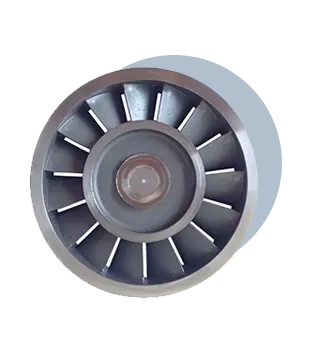
Precision-engineered and heat-tolerant
Nozzle guide vanes (NGVs) are a key component in managing airflow in turbine applications. They act as stationary airfoils, compressing hot air and creating a uniform velocity profile for improved aerodynamic performance. They do this because of their complex geometry - a mix of concave surfaces and holes. This complexity makes it difficult to forge them, coupled with the fact that these vanes are made with superalloys. These castings are critical for turbine efficiency, making nozzle guide vane components a key focus in high-performance engineering.
Investment castings for nozzle guide vanes are the most reliable solution for producing complex, high-temperature components used in gas turbines and aerospace applications, and that is what we at Super Quali Cast specialize in. We produce precision investment castings for nozzle guide vanes with long service life while handling temperatures in the 1500°C range with excellent high-temperature resistance, making us a reliable NGV castings manufacturer for critical turbine applications.
As a leading investment castings manufacturer for nozzle guide vanes in India, Super Quali Cast supplies high-performance turbine components to global OEMs and turbine manufacturers. Not only do we manufacture nozzle guide vane castings in India, but we also supply them to major international markets.
Investment Castings for Nozzle Guide Vanes - Our Manufacturing Process
Our process for investment castings for nozzle guide vanes is designed to achieve high dimensional accuracy, superior surface finish, and structural integrity required for high-temperature turbine applications.
- High-Precision Molding: Ensures repeatable geometric accuracy for the vanes.
- Investing: Creates the ceramic shell around the mold, which later becomes the cavity.
- Heat Treatment: Establishes hardness by enhancing the single-crystal grain structure.
- Gravity Pouring: Assures an even pour and arrests shrinkage and porosity.
- CNC Machining: Adds finishing touches to a multiplicity of holes and slots.
- Final Inspection: visual, fluid-penetrant, and dimensional checks to guarantee defect-free output.
Technical Specifications of Our Nozzle Guide Vane Casting
| Specification Area | Details |
|---|---|
| Development & Sampling | 25-40 days |
| Casting Process | Investment Casting, Lost-wax Casting |
| Material Grades | Nickel-based Superalloys |
| Industry Standards | ASME PTC 22, ISO 21789, ASTM A297 |
| Shell Building Media | Ceramic, Stucco |
| Casting Weight Range | 3-20 Kg |
| Maximum Dimensions | 350 mm x 150 mm x 100 mm |
| Minimum Wall Thickness | 1.5 mm |
| Casting Tolerances | CT4-CT5 |
| Heat Treatment Options | Homogenization, Quenching, Aging |
| Surface Treatment Options | Ceramic coating |
Note: Certain specifications are subject to change based on design and material choice.
Why Choose Us for Investment Castings for Nozzle Guide Vanes
Precision investment castings for nozzle guide vanes are non-negotiable when it comes to performance. Here’s why you should consider partnering with us to meet your product-application fit.
Proven Experience in Nozzle Guide Vanes Investment Castings
Super Quali Cast manufactures a wide range of precision investment castings for critical engineering applications. The experience we have accumulated helps us design and manufacture nozzle guide vane castings that meet your requirements.
Advanced Manufacturing Capabilities
Our state-of-the-art foundry uses a ‘human-in-the-loop’ manufacturing approach that ensures quality control while maintaining economies of scale. This helps us utilize the best of our lost-wax investment casting expertise across simple and intricate castings.
Material & Application Versatility
We cast with a variety of metals and alloys, including nickel-based superalloys such as Hastelloy and Inconel. These materials are popular for meeting demanding service conditions and are the main reason why we use them for nozzle guide vanes.
Quality, Testing & Global Supply Readiness
We are an ISO 9001 investment casting foundry with support for secondary operations and in-house testing. As a leading investment castings exporter, we maintain a clear understanding of international regulations and compliance requirements.
Currently, we support manufacturers and OEMs in the US, the UK, and Canada. We also supply to businesses in the UAE, Saudi Arabia, Japan, Taiwan, and Brazil.
About Super Quali Cast: Investment Casting Manufacturer for Branch Pipe Applications
Super Quali Cast is a trusted investment castings manufacturer in India, known for delivering precision-engineered components for demanding industrial and turbine applications worldwide.
Decades of Experience
Four decades of investment casting excellence.
Focused Manufacturing
Casting for Automotive, Railways, Agriculture, and General Engineering.
Global Reach
Exporting to the US, UK, Canada, Brazil, the UAE, Saudi Arabia, Japan, and Taiwan.
End-to-End Capabilities
In-house designing, molding, casting, secondary operation, and testing.
Production Scale & Compliance
2,400 metric tons of annual production. We are ISO, Merkblatt, PED, and IBR-certified.
Discuss Your Nozzle Guide Vane Casting Needs
Connect with our experts to discuss design feasibility, material choices, and MOQs.
FAQs
What material is used for casting nozzle guide vanes?
We use nickel-based superalloys for casting nozzle guide vanes. Superalloys are preferred over stainless steel because of their higher heat and corrosion resistance. Furthermore, they prevent creep and warping at high temperatures and ensure prolonged service life.
Where are nozzle guide vanes located?
Nozzle guide vanes are located at the entrance of each turbine stage.
Why is investment casting suitable for nozzle guide vanes?
Nozzle guide vanes have complex geometry that involves hollow spaces, curves, and protrusions. This makes it difficult to forge or produce using standard means. This is why investment casting is preferred for producing nozzle guide vanes.
What is the function of nozzle guide vanes?
The function of nozzle guide vanes is to stabilize airflow and direct it to the turbine blades. It also helps cool down the air somewhat as it flows into the turbine, thereby providing a degree of temperature control.
What is the difference between NGVs, IGVs, and VGVs?
These are three different types of vanes, each mapped to a different part of the engine. IGVs and VGVs are part of the compressor, whereas NGVs are part of the turbine.
Power Plant Investment Casting Solutions
High-performance casting components engineered for critical flow control applications across global industries.